From our sites
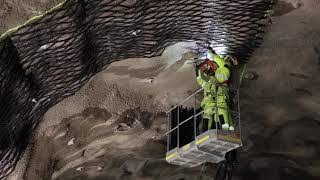
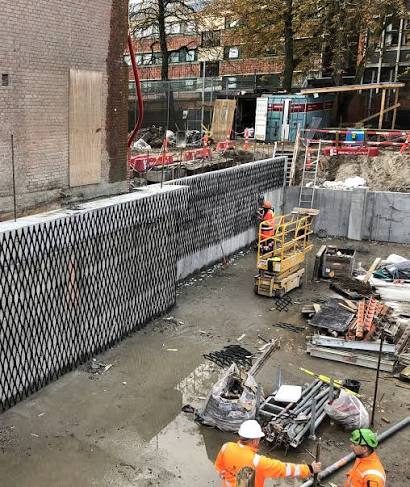
Sealing a structure against water is only half the problem — the pressure behind that seal has to go somewhere. Negative-side drainage solves the other half.
Request a quoteUnderground structures — tunnels, basements, shafts, retaining walls — sit permanently below the water table or within saturated ground, and groundwater will always find a path toward the lowest-pressure route available. A waterproofing membrane alone blocks that path but does nothing to relieve the pressure building up behind it; over time, that trapped hydrostatic pressure is what drives leaks, cracking and long-term damage to the lining or structural shell.
Negative-side drainage — installed on the inside face of the structure, behind the final lining or shotcrete — gives that water a permanent, engineered channel to drain away through, rather than letting pressure accumulate until it finds its own way through a weak point.
Positive-side (external) membrane waterproofing — bituminous or PVC membranes applied to the outer face before backfilling — is the traditional first line of defence, but is only accessible during new construction and cannot be inspected or repaired once buried. Positive-side spray-applied membranes offer similar limitations. Negative-side modular drainage systems (such as Dolenco Drain, one of our supply partners) use a network of slim, interconnected drainage channels fixed to the internal face and covered with shotcrete or lining, permanently relieving water pressure rather than only resisting it. French drains and perimeter drainage pipes serve a related role for basements accessible from outside during construction.
A correctly designed negative-side drainage layer is a permanent solution — it continues to relieve water pressure for the structure's full service life, including cases where the original waterproofing membrane later develops defects, since the drainage channel still has somewhere to direct the water rather than letting pressure build behind a failed seal. This is particularly valuable for existing structures showing water ingress, where it is rarely practical to excavate and repair external membranes, and for new structures where reducing embodied CO₂ and construction time both matter.
Getting it wrong — relying on membrane alone, or an undersized drainage capacity — leaves the structure vulnerable to the exact slow-building pressure failure the drainage layer exists to prevent.
| Method | Pros | Cons |
|---|---|---|
| External membrane (positive-side) | Well-established, effective first line of defence during new construction | Not accessible for inspection or repair once backfilled; does not relieve trapped water pressure |
| Spray-applied membrane | Conforms well to complex geometries | Same access/inspection limitation as external membranes once covered |
| Negative-side modular drainage | Works on new and existing structures; permanently relieves pressure rather than just resisting it; low space requirement; durable design life | Requires internal face access during installation; typically paired with, not a full replacement for, a base waterproofing layer |
| Perimeter/French drains | Simple, well-understood for basements accessible during construction | Only practical where external excavation access exists |
Volz designs negative-side drainage layouts around the structure's actual water inflow and geometry, then supplies and installs the modular channel network end to end — new-build or retrofit, tunnel, basement or retaining structure.