How it's engineered
Typical System Schematic
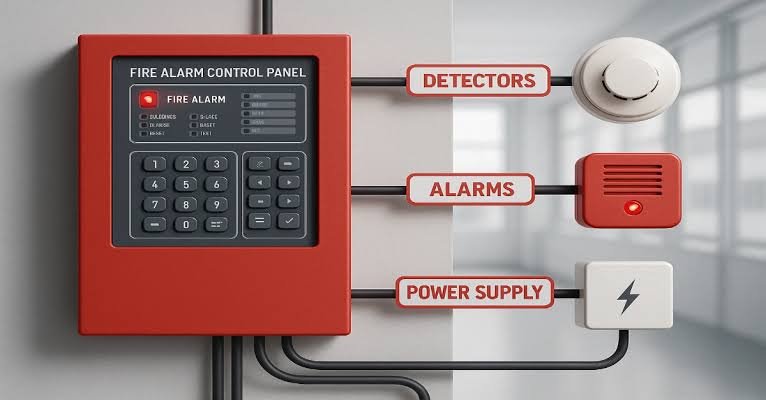
Typical fire alarm control panel wiring — detectors, alarms and power supply engineered as one integrated loop
Early, accurate detection is what makes every other fire safety system — sprinklers, evacuation, suppression — effective in time.
Request a quoteTypical fire alarm control panel wiring — detectors, alarms and power supply engineered as one integrated loop
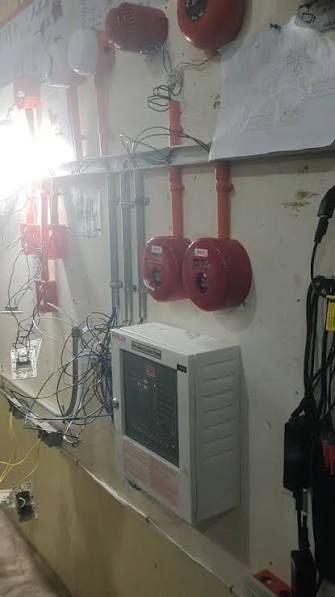
A fire alarm system's job is speed: detecting a fire in its earliest stage and notifying occupants and responders before it grows beyond what sprinklers or manual firefighting can contain. Every minute of delay in detection translates directly into more fire growth, more smoke spread, and less time for safe evacuation.
Fire alarm systems are also the layer that triggers everything else — HVAC damper closure to stop smoke spread, lift recall, access-control unlocking for evacuation routes — so their reliability affects the whole building's fire strategy, not just the alarm bell.
Conventional systems wire detectors in zones and identify only which zone triggered — simpler and cheaper, suited to smaller buildings. Addressable systems identify the exact device that triggered, giving precise location information critical in larger or more complex buildings. Aspirating smoke detection (ASD) actively samples air through a pipe network and can detect smoke at very low concentrations, used in high-value or high-risk spaces like data centres and archives.
Fast, accurately located detection measurably reduces evacuation time and fire spread, and is frequently the deciding factor between a contained incident and a major loss. Integration with HVAC and access control prevents smoke from spreading through ductwork and ensures escape routes unlock automatically rather than depending on someone with a key being present.
A poorly designed or under-maintained system produces false alarms (which erode occupant trust and response) or, worse, fails to detect a real fire in time.
| Method | Pros | Cons |
|---|---|---|
| Conventional | Lower cost, simpler wiring, adequate for small single-zone buildings | Only zone-level location; less diagnostic information |
| Addressable | Exact device-level location; supports large, complex, phased-evacuation buildings | Higher system and panel cost |
| Aspirating (ASD) | Extremely early, very low-concentration smoke detection | Higher cost; needs pipe network design and regular filter maintenance |
Volz engineers detection and notification coverage to NFPA 72 and integrates alarm panels with HVAC shutdown, access control and BMS at design stage — not as an afterthought once installation is already underway.